

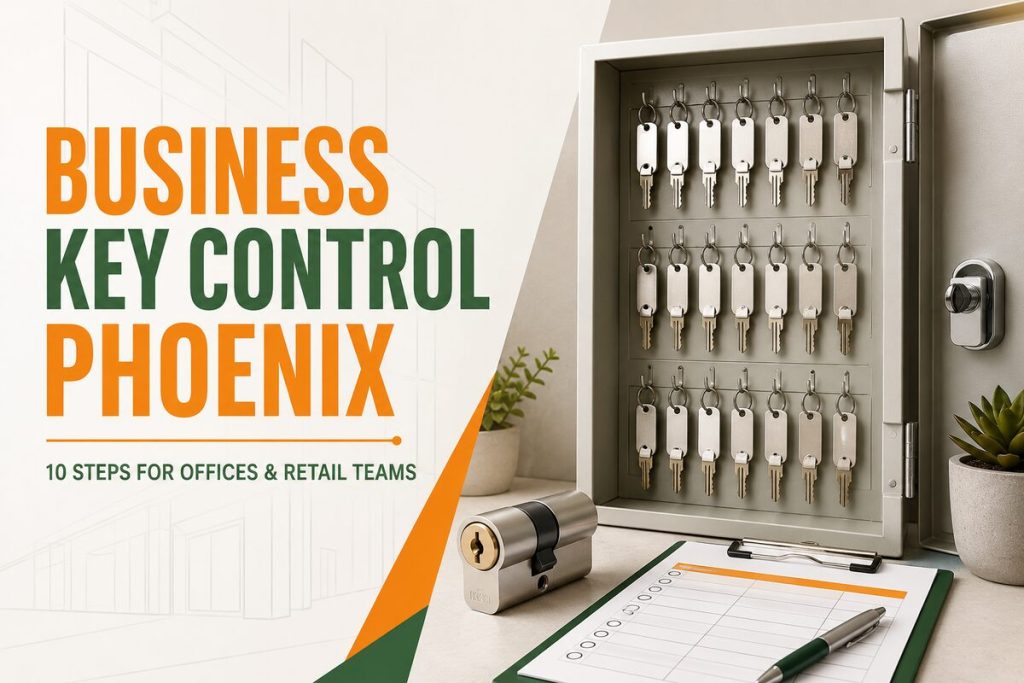
High-security locks for businesses in Phoenix can strengthen key control, resist common forms of manipulation, and support more reliable access management. They are especially useful for properties that protect inventory, records, equipment, cash, or restricted work areas.
High security does not mean choosing the most expensive lock. The right solution must match the door, frame, traffic level, access policy, and risks of the property. This guide explains the principal features and decisions involved.
What makes a commercial lock high security?
High-security systems may combine stronger cylinders, controlled keyways, reinforced components, protection against drilling or picking, and documented authorization for key duplication. Features vary by manufacturer and model, so a professional evaluation is important.
The lock is only one part of the opening. A strong cylinder cannot compensate for a weak frame, loose strike, damaged door, exposed hinges, or unsuitable installation.
Standard locks vs. high-security locks
| Factor | Standard commercial lock | High-security option |
|---|---|---|
| Key duplication | May be widely available | Often controlled by authorization |
| Cylinder protection | Basic resistance | Enhanced resistance varies by model |
| Access planning | Simple keying | Can support controlled hierarchies |
| Cost | Lower initial expense | Higher investment for added control |
Businesses that may benefit most
High-security locks can be valuable for retail stores, medical offices, warehouses, professional offices, restaurants, schools, apartment management offices, and industrial facilities. They are also useful for interior rooms that contain sensitive records, controlled inventory, network equipment, medications, tools, or keys.
Properties with frequent employee turnover or many authorized users may benefit from stronger key-control procedures even when the burglary risk is moderate.
Key features to evaluate
Restricted or controlled key duplication
A controlled key system limits where and how additional keys can be obtained. Policies may require identification or documented authorization. This helps reduce unauthorized copying and provides a clearer process for issuing replacements.
Resistance to manipulation and physical attack
Some cylinders include features intended to resist picking, drilling, pulling, or other attacks. The level of protection varies, and claims should be compared using available certifications and manufacturer documentation.
Durable commercial construction
Busy entrances require hardware designed for repeated daily cycles. The lever, latch, cylinder, strike, fasteners, and door closer must work together without binding.
Master key compatibility
A master key system can give employees access only to assigned areas while managers hold broader permissions. The hierarchy should be documented and planned with room for future expansion.
Electronic access integration
Some businesses combine mechanical high-security cylinders with electronic access control. Credentials may be easier to deactivate than physical keys, while mechanical override access supports specific operational needs.
How to identify the doors that need an upgrade
Begin with an inventory of exterior entrances, employee doors, delivery points, offices, storage rooms, utility areas, gates, and emergency exits. Record who uses each opening, what it protects, and what would happen if the door failed or unauthorized access occurred.
Prioritize doors with lost or uncontrolled keys, signs of tampering, unreliable operation, valuable contents, weak frames, or outdated hardware. Not every door requires the same level of protection.
Why the door and frame matter
A security upgrade should include the strike plate, frame condition, door material, hinge or pivot condition, latch alignment, and closer operation. Reinforcement may be needed when the surrounding structure cannot support the intended lock.
For storefront doors, compatible dimensions and careful installation are essential. Exit doors must continue to provide required egress; improvised bars or secondary locks can create safety problems.
High-security locks and Phoenix conditions
Heat, direct sunlight, dust, and heavy use can aggravate wear. Exterior hardware should suit its environment, and moving components should receive manufacturer-appropriate maintenance. Household oils can attract dirt and should not be used inside cylinders.
Doors that work differently during the hottest part of the day may have alignment or expansion issues. A locksmith should diagnose the entire opening before replacing hardware.
Building an effective key-control policy
- Issue keys only after documented authorization.
- Record the key identifier, recipient, date, and permitted areas.
- Prohibit informal duplication.
- Recover keys immediately after employment or tenancy changes.
- Store unused and master keys in a secure location.
- Review access permissions on a regular schedule.
- Respond promptly when a key is lost or unaccounted for.
Rekey, replace, or upgrade?
Rekeying may be sufficient when existing hardware is reliable but access must change. Replacement is appropriate when components are worn, damaged, obsolete, or incompatible. A high-security upgrade addresses broader goals such as controlled duplication, attack resistance, standardization, and scalable access.
The decision should consider total cost, not only the purchase price. Include key management, expected service life, future expansion, maintenance, and the operational cost of a lock failure.
Questions to ask before installation
- Which doors and rooms require the strongest protection?
- How many users need access, and at what level?
- Who can authorize duplicate or replacement keys?
- Will the system need to expand?
- Does the hardware meet the door’s traffic and egress needs?
- What maintenance and documentation are required?
Strengthen access control for your business
West Phoenix Locksmith can inspect your doors, review key-control needs, and recommend compatible commercial hardware.
Contact us to discuss high-security locks for businesses in Phoenix.
A stronger lock begins with a stronger plan
High-security hardware provides the greatest value when it is part of a complete access strategy. Matching protection to real risks, reinforcing the full opening, and documenting every key can help a Phoenix business reduce vulnerabilities while keeping daily access practical.
Frequently asked questions
Can high-security keys be duplicated?
Many systems restrict duplication through authorized channels and documentation. The exact controls depend on the key system and manufacturer.
Do all business doors need high-security locks?
No. Protection should match the risk, contents, access needs, and construction of each opening. A survey helps prioritize upgrades.
Can high-security locks use a master key system?
Many commercial systems support planned key hierarchies. Compatibility and expansion capacity should be confirmed before installation.
Should the frame be reinforced too?
Often, the entire opening should be evaluated. A strong lock performs best with a sound door, properly aligned latch, secure strike, and suitable frame.
Learn about our commercial locksmith services. For general physical-security guidance, see resources from CISA.
Need professional locksmith assistance?
West Phoenix Locksmith can inspect the property, recommend compatible hardware and provide dependable service in Phoenix.
How long does high-security business locks usually take?
The time depends on the door, existing hardware, required preparation and system complexity. An inspection provides the most accurate estimate.
Can existing hardware be reused during high-security business locks?
Sometimes. A locksmith should confirm that each component is compatible, undamaged and appropriate for the intended security level.
Should high-security business locks be handled by a professional locksmith?
Professional service helps ensure correct fit, alignment, safe operation and compatibility with the complete door or access system.
What should I prepare before scheduling high-security business locks?
Provide photos when possible, describe the problem, identify the door or lock type and make sure an authorized representative can provide access.
How can I maintain the results after high-security business locks?
Test operation regularly, keep the area clean, address alignment problems early and schedule service when performance changes.
Can high-security business locks improve property security?
It can improve security when the hardware matches the door, user needs and access plan. The surrounding frame and related components also matter.