

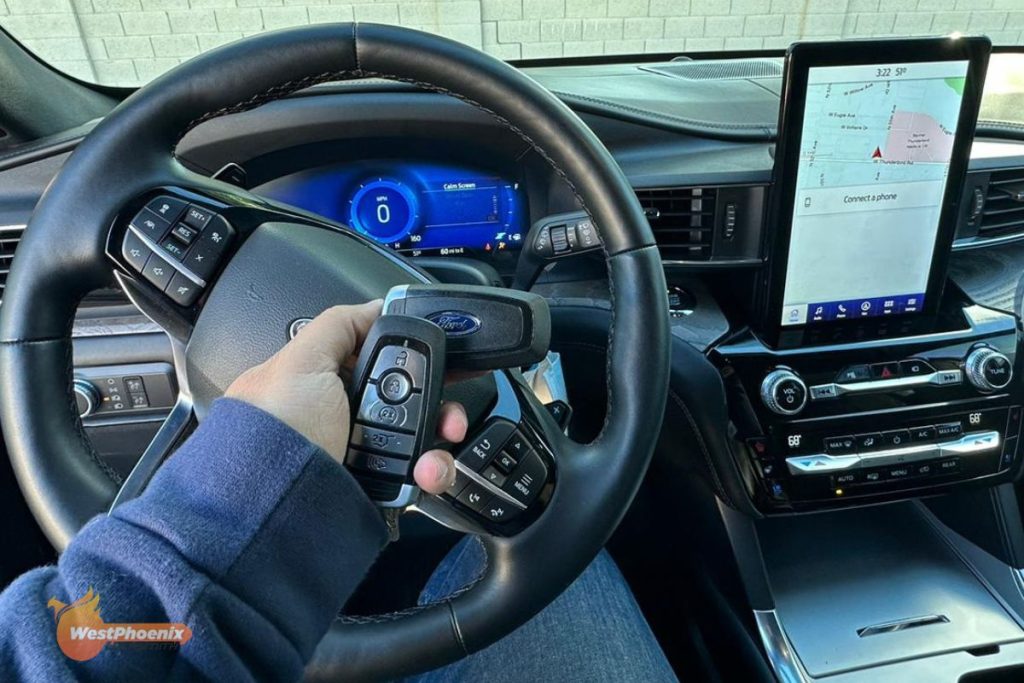
Thermal expansion causes micro-fractures in the solder joints of transponder chips and immobilizer antenna rings. When the dashboard temperature exceeds 160°F, the resistance in the copper windings changes, disrupting the low-frequency RFID signal required to authorize the engine start. If the ECU detects an incomplete or corrupted 40-bit or 80-bit encrypted string, it immediately cuts fuel injection to the cylinders. This is a hardware failure, not a dead battery issue.
The Mechanics of the Immobilizer “Handshake”
Most drivers in the Valley assume their key is just a piece of metal. It isn’t. It is a cryptographic device. When you insert your key into the ignition cylinder, an induction coil (the antenna ring) around the lock housing energizes the passive RFID chip embedded in the head of your key. This chip doesn’t need a battery; it draws power from the magnetic field generated by the car.
Once energized, the chip transmits a unique alphanumeric code to the vehicle’s Immobilizer Control Unit (ICU). The ICU relays this to the Engine Control Unit (ECU). If the codes match the stored values in the EEPROM memory, the fuel pump engages. If they don’t, the engine cranks but never fires, or it starts and stalls within two seconds.
In Phoenix, we see this fail constantly between June and September. The extreme heat alters the electrical properties of these components. A key that works in the cool morning might fail completely after the car has been parked in a relentless Sun City driveway all afternoon. We specialize in transponder key programming to correct these specific environmental failures.
Identifying the “Start-Stall” Symptom
You need to recognize the difference between a starter failure, a fuel issue, and an immobilizer lockout. A mechanical failure usually results in a clicking noise or no crank at all. An immobilizer failure allows the engine to crank vigorously. The engine wants to run, but the computer is forbidding it.
Watch the security light on your dashboard. It is often a padlock icon or a red dot.
- Solid Light: The system does not detect a transponder chip at all.
- Flashing Light: The system detects a chip, but the alphanumeric code is invalid.
If you see these signs, hitting the starter motor repeatedly will only drain your battery. The handshake has failed. You need a technician to interface with the OBD-II port to diagnose exactly where the signal dropped. Our mobile emergency locksmith service brings the diagnostic scanners directly to the vehicle location.
Why Arizona Heat Kills Transponders
We handle calls from Glendale to Buckeye where the key simply stopped working. The culprit is almost always thermal stress.
1. Circuit Board Delamination
Modern remote head keys combine the remote keyless entry (buttons) and the transponder chip onto a single PCB. Intense heat causes the board to flex. This flexing cracks the microscopic solder joints connecting the transponder coil to the main chip. The connection becomes intermittent. You might find that squeezing the key head allows the car to start. This is a temporary fix. The key is dying. We recommend immediate new key fob creation before the circuit severs completely.
2. Carbon vs. Glass Chip Degradation
Older vehicles use glass ampoule transponders (Megamos crypto). These are hermetically sealed and robust against heat but fragile against impact. Newer keys use carbon wedge chips. Carbon chips are durable against drops but susceptible to heat warping. If the resin casing warps, it puts pressure on the internal semiconductor, shifting its frequency. A shift of even a few Hertz can prevent the antenna ring from reading the data. In these cases, we perform car key duplication using a fresh chip and clone the data from the failing unit while it is still readable.
3. Antenna Ring Resistance
The failure isn’t always the key. The copper coil around your ignition cylinder expands in the heat. As the wire lengthens, resistance increases. If the resistance goes out of the manufacturer’s specified range (usually 2-8 Ohms), the magnetic field becomes too weak to energize the transponder.
The Diagnostic Process: OBD-II Interfacing
We don’t guess. We scan. When we arrive at a vehicle lockout or a non-start situation, we plug a high-level programmer into the OBD-II port. This bypasses the need for towing the car to a dealership.
The scanner communicates directly with the BCM (Body Control Module). We check for fault codes like P1610 (Lock Mode) or B2799 (Immobilizer System Malfunction). Once we identify the blockage, we can clear the error cache. If the key is corrupted, we erase it from the memory and program a new one.
For newer vehicles with “all keys lost” scenarios, the process is more invasive. We may need to pull the dashboard cluster to access the EEPROM chip directly, “flashing” the memory to accept new keys. This is common in Toyota and Honda models found throughout Avondale and Tolleson. This advanced work requires precision soldering tools and clean data protocols to avoid bricking the ECU.
Smart Keys and Proximity Fob Failures
Push-to-start vehicles operate on a similar principle but use a continuous low-energy signal. Heat affects the battery life of these fobs significantly. However, a dead battery in a smart key should not leave you stranded. Every manufacturer builds in a “limp mode” or a dead fob slot—usually near the cupholder or by holding the fob directly against the start button.
If holding the fob to the button fails, the proximity sensor antenna in the car’s console may be damaged. We provide car digital and remote key reprogramming to re-sync the rolling codes between the fob and the car’s receiver.
Mechanical Wear in High Temperatures
Heat doesn’t just kill electronics; it affects the brass and steel of the lock cylinder itself. Lubricants dry out and turn into a gummy varnish. When you force a key into a dry, overheated ignition, you risk shearing the blade or bending the wafers.
If your key turns halfway and gets stuck, do not force it. You will break the head off. We frequently perform broken key extraction in Laveen parking lots because a driver tried to muscle a jammed lock. Once the debris is removed, we may need to rebuild the ignition housing or cut a new key by code to ensure the cuts are sharp and precise.
Dealer vs. Locksmith: The Programming Reality
Dealerships will tell you that you must tow the vehicle to them for programming. They often require replacing the entire computer unit if the system locks up. This is unnecessary and expensive. A skilled technician can reset the immobilizer module without replacement.
We carry OEM-grade programmers capable of pulling PIN codes for Chrysler, GM, Nissan, and Ford vehicles. We cut the blade on-site using high-precision CNC mills. We program the chip in the driveway. This includes emergency car key replacement for modern transponders and laser-cut sidewinder keys.
Service Coverage Across the Valley
Transponder failure is a specific beast. It requires knowledge of electrical resistance, radio frequencies, and automotive software. We cover the entire metro area.
- West Valley: Drivers in Surprise and Goodyear face some of the highest temperatures. We carry extra stock of high-heat resistant composite keys for these areas.
- Central Phoenix: From downtown to Phoenix suburbs, we navigate the grid efficiently to reach stranded drivers.
- East Valley: We extend our technical services to Mesa and Tempe, dealing with the heavy commuter traffic breakdowns.
Summary: Technical Precision Matters
When your car refuses to start in 115-degree heat, don’t bang on the steering column. Recognizing a handshake failure saves time. It is an invisible, digital conversation that has gone silent.
We restore that conversation. We analyze the signal strength, cut a fresh blade to factory code, and rewrite the encrypted authorization to the ECU. Whether you need a simple programmed car key or a complex ignition rebuild, we have the tools in the truck to handle the job.
If your security light is flashing and the engine won’t catch, check the code. Then call a technician who understands the data behind the metal.
Contact us for immediate diagnostic routing.
Frequently Asked Questions
Car key replacement in Phoenix typically ranges from $75 to $300 depending on the make and model. At West Phoenix Locksmith, we offer competitive pricing with on-site service across Phoenix, AZ—no need to tow your vehicle to a dealership.
Yes, a licensed locksmith can program transponder keys for most vehicle makes. West Phoenix Locksmith has the professional equipment to cut and program keys on-site throughout the Phoenix metro area.
Call a local locksmith immediately. West Phoenix Locksmith provides 24/7 car lockout service in Phoenix, AZ, with typical response times of 20–30 minutes. Avoid trying to force entry, as it can damage your vehicle.
Yes, we service all major brands including Toyota, Ford, Chevrolet, Honda, BMW, Mercedes, and more. Our Phoenix automotive locksmiths carry the tools and key blanks for virtually every vehicle on the road.
A local locksmith is almost always more affordable and faster than a dealership. West Phoenix Locksmith typically saves customers $100–$200 compared to dealership prices for car key replacement in Phoenix.
Most car key replacements take 20–60 minutes on-site. West Phoenix Locksmith comes to your location anywhere in Phoenix, AZ, so you don’t have to wait at a shop or dealership.
Yes. Our Phoenix locksmiths carry common key fob batteries and can replace them on-site in minutes. If your fob needs reprogramming after a battery swap, we handle that too.
A smart key uses proximity sensors to unlock and start your vehicle without inserting a key. West Phoenix Locksmith can duplicate and program smart keys for most vehicles right here in Phoenix, AZ.
Absolutely. West Phoenix Locksmith is available 24 hours a day, 7 days a week for emergency car lockouts, broken keys in ignition, and key replacements anywhere in the Phoenix, AZ metro area.
Signs include a key that won’t turn, a stuck key, or a worn key that no longer works. West Phoenix Locksmith can diagnose and replace ignition cylinders on-site in Phoenix, AZ, often faster and cheaper than a dealership.
🔒 Need a trusted locksmith in Phoenix? West Phoenix Locksmith provides 24/7 service across Phoenix and the West Valley. Explore our full range of locksmith services, contact us for a free quote, or find us on Google Maps.